Queer Places:
Friedhof Sihlfeld, Aemtlerstrasse 151, 8003 Zürich, Switzerland
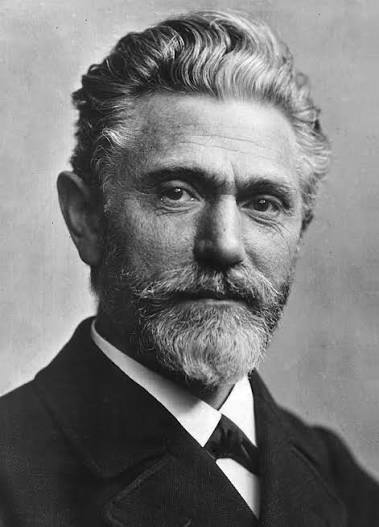 August Bebel (February 22, 1840 – August 13, 1913) was a foundational figure in the history of German socialism and the international labor movement. As a co-founder and
long-term leader of the Social Democratic Party of Germany (SPD), he became one of the most influential political figures in late 19th-century Europe.
August Bebel (February 22, 1840 – August 13, 1913) was a foundational figure in the history of German socialism and the international labor movement. As a co-founder and
long-term leader of the Social Democratic Party of Germany (SPD), he became one of the most influential political figures in late 19th-century Europe.
Born into poverty in Deutz (near Cologne), Bebel was orphaned at a young age and worked as a journeyman woodturner. This background gave him a firsthand understanding of
the hardships faced by the working class, which fueled his later political radicalism.
In the 1860s, he became active in workers' associations in Leipzig. In 1869, he joined forces with Wilhelm Liebknecht to co-found the Social Democratic Workers' Party
(SDAP), which merged in 1875 to become the SPD.
Bebel served in the North German Reichstag and later the German Reichstag from 1867 until his death in 1913. He led the SPD through periods of intense repression, most
notably during Bismarck’s "Anti-Socialist Laws," and helped build the party into the largest and most powerful socialist organization in Europe.
He is perhaps best remembered for his book Woman and Socialism (1879), which argued that the liberation of women was inextricably linked to the abolition of the
capitalist system.
August Bebel is historically significant to the LGBTQ movement for being the first politician to speak out in favor of homosexual rights in a national parliament.
On January 13, 1898, during a debate in the Reichstag regarding reforms to the German penal code, Bebel used his platform to advocate for the repeal of Paragraph 175,
the law that criminalized sexual acts between men.
Bebel was one of the early signatories of a petition organized by Magnus Hirschfeld and the Scientific-Humanitarian Committee (WhK). The petition sought to overturn
Paragraph 175, arguing that homosexuality was a natural variation of human sexuality rather than a crime.
While Bebel personally expressed views that aligned with the moral conventions of his time—at times referring to same-sex relationships as "against nature"—his political
stance was driven by the socialist belief that the state should not interfere in the private lives of consenting adults. His willingness to bring this issue into the
political mainstream provided critical legitimacy to the early homosexual rights movement.
Under Bebel’s leadership, the SPD became the only major political party of that era to consistently advocate for the decriminalization of homosexuality. This set a
precedent for the socialist movement’s involvement in LGBTQ advocacy, which continued into the Weimar Republic.
Bebel’s intervention remains a landmark moment in political history, as it marked the first time the rights of homosexuals were treated as a matter of civil liberty
rather than purely a moral or medical issue in a legislative setting.
References:
- Gayday by Massimo Consoli, 2005
- https://www.bloomsbury.com/us/august-bebel-9781788314459/
- https://www.britannica.com/biography/August-Bebel
- https://en.wikipedia.org/wiki/August_Bebel
- https://libcom.org/article/my-life
- https://socialistworker.co.uk/in-depth/sexuality-and-struggle-in-weimar-germany/
- https://www.marxists.org/archive/bebel/1898/01/13.htm
- https://www.bostonreview.net/articles/gay-liberation-behind-iron-curtain/
- https://isj.org.uk/the-bolsheviks-and-sexual-liberation/
Support this project
This website is a passion project researched, developed, and funded entirely by me. If you find the content valuable and would like to help support the ongoing research and hosting costs, any contribution is deeply appreciated.
Thank you for keeping this independent resource alive!
My books on Amazon: Elisa Rolle's books
BACK TO HOME PAGE